How Scar Tissue in My Chest Led to a New Heart Valve
Life can change fast. Sometimes it’s one symptom. One scan. One “we’re not sure yet.” And suddenly you’re on a long road you never asked to be on.
My story isn’t just about heart disease. It started with an idiopathic rare disease that most people including doctors have never even heard of. That rare disease set off a chain reaction that eventually led to something wild: a 52mm EVOQUE transcatheter tricuspid valve replacement—basically a new heart valve placed through a catheter, not open-heart surgery.
This is my journey—from scar tissue in my chest… to a “re-engineered” heart… to a second chance I will never take for granted.
The Unseen Enemy
It all began with Fibrosing Mediastinitis (FM).
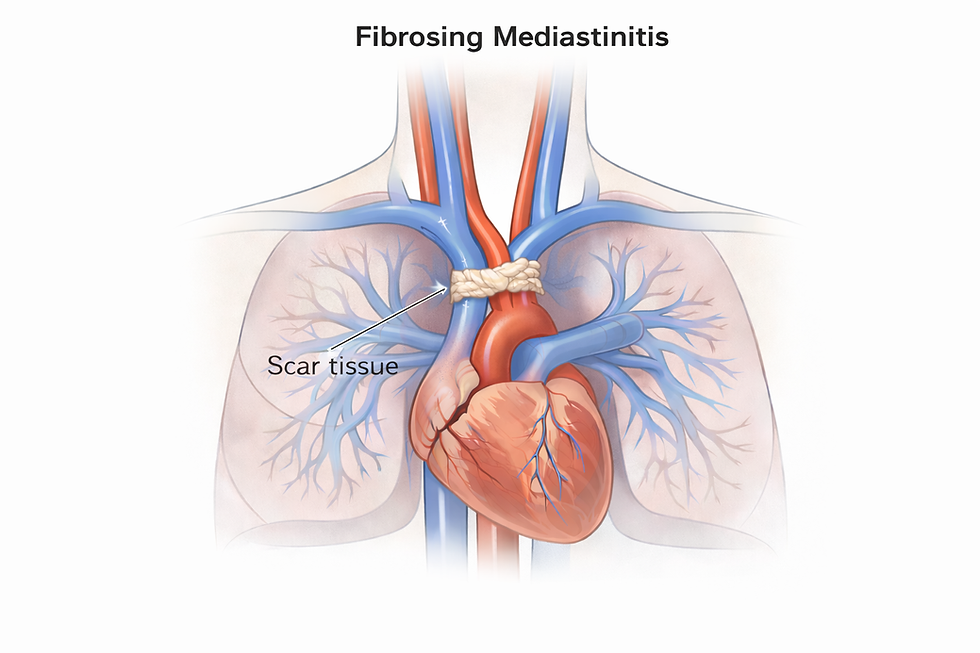
FM is scar tissue that grows in the middle of your chest (the mediastinum). But it’s not normal scar tissue. It can act like a tight, stiff web that keeps growing and starts squeezing things it has no business touching.
For me, it went after my pulmonary arteries—the big blood vessels that carry blood from my heart to my lungs.
The Traffic Jam Inside My Body
Your heart is like a strong pump.And your pulmonary arteries are major highways to the lungs.
Now imagine scar tissue slowly wrapping around those highways like a zip tie.
The more it tightens, the harder it is for blood to get through, leaving the body struggling to get enough oxygen.
That “traffic jam” is what caused my next big problem…
High Pressure, High Stakes
Because my pulmonary arteries were getting squeezed, my heart had to push harder to get blood to my lungs.
That led to pulmonary hypertension—which is basically high blood pressure in the lungs (not your arm-cuff blood pressure).
And when that pressure stays high long enough, it starts wearing down the right side of the heart (cor pulmonale)—meaning the right side of the heart gets strained and starts struggling.
This is where things got serious for me.
Years of Interventions, One Goal
To open those “highways” back up, I went through major steps, including:
Surgical bypass: In 1987, surgeons used a Dacron graft—a strong medical fabric tube—to route blood around the scar tissue.
Pulmonary artery stents (tiny metal scaffolds to hold the arteries open)
Balloon angioplasty (inflating a balloon inside the stent when it narrowed again)
Even after stents, I had restenosis—which is a fancy word for “it narrowed again.”
So it wasn’t one-and-done. It was years of pushing forward and staying on top of it.
How the Strain Finally Showed Up
Over time, all that pressure and strain caused the right side of my heart to enlarge and weaken.
That’s when my tricuspid valve started leaking badly.
It didn’t close tightly, which meant blood leaked backward instead of moving forward.
I can tell you personally that when a valve leaks, everyday things like breathing, walking, and energy become harder even impossible at times.
The Procedure That Changed Everything
Eventually, I needed a full valve replacement.
But I wasn’t a candidate for open-heart surgery, so the option that changed my life was transcatheter tricuspid valve replacement (TTVR) through a clinical trial, prior to FDA approval.).
That’s how I ended up with a 52mm EVOQUE valve.
This was the procedure that was a turning point.
It didn’t erase the journey. It made moving forward possible.
Strength I Earned
This is the outcome of persistence, not luck.
I’m doing well.
I work out at the gym 3–4 times a week and keep active by walking my neighborhood regularly.
You might even catch me traveling and doing more than people expect from someone who was once so sick.
✧ My breathing has been good.
✧ No swelling.
✧ No constant dizziness.
✧ And most days, I feel stable.
That has nothing to do with luck.I’m owning this! That’s persistence + good medical care + advocating my butt off.
With my history, I don’t ignore signs. I document them. I speak up. I ask questions.
Because that’s what this journey has taught me:
You can’t afford to stay quiet in a system that moves too fast.
Why I’m Sharing This
I’m sharing this because rare diseases like fibrosing mediastinitis can be misunderstood, dismissed, or missed.
And because tricuspid valve disease—especially in women—gets minimized way too often.
If any of this sounds familiar, it’s a sign to keep asking questions and trust what your body is telling you.
Learning what questions to ask can make a difference.


Comments